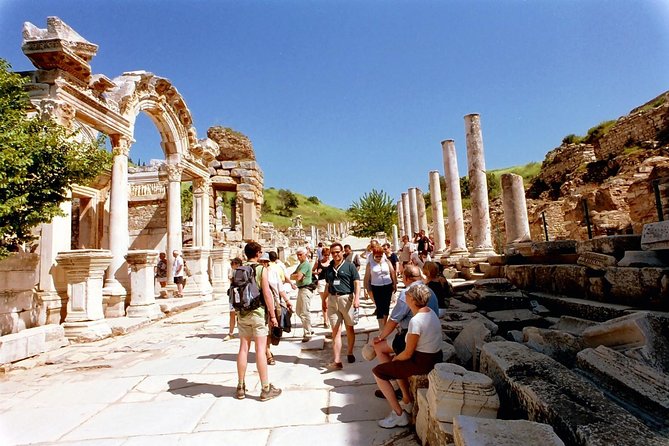
Explore some of the top must-see sights in western Turkey on a convenient one or two-days tour. Spend the first day at Ephesus, an ancient city, as well as other sites of historical and archaeological interest around the town of Selcuk. On day two, travel to the natural wonder of Pamukkale and the ancient town of Hierapolis. This is an easy way to fit these two unmissable areas into two days.
Highlights
2 days
Offered in German (Deutsch) & 4 Others
Free Cancellation
Mobile Ticket
2 days
Offered in German (Deutsch) & 4 Others
Free Cancellation
Mobile Ticket
What's Included
Transportation in a comfortable air-conditioned vehicle
Private professional Driver
Private professional licensed guide
Entrance fees to the sights mentioned above in the Itinerary
Gratuities for your guide and Driver
Drinks (unless specifically mentioned)
Important Information
•
Wheelchair accessible
•
Public transportation options are available nearby
•
Suitable for all physical fitness levels
•
May be operated by a multi-lingual guide
•
NA
Cancellation policy
For a full refund, cancel at least 24 hours before the scheduled departure time.
•
For a full refund, you must cancel at least 24 hours before the experience’s start time.
•
Cut-off times are based on the experience’s local time.
•
If you cancel less than 24 hours before the experience’s start time, the amount you paid will not be refunded.
•
This experience requires a minimum number of travelers. If it’s canceled because the minimum isn’t met, you’ll be offered a different date/experience or a full refund.
•
Any changes made less than 24 hours before the experience’s start time will not be accepted.
Become our Lokal Curator
Are you ready to turn your hobbies into a business?
Explore some of the top must-see sights in western Turkey on a convenient one or two-days tour. Spend the first day at Ephesus, an ancient city, as well as other sites of historical and archaeological interest around the town of Selcuk. On day two, travel to the natural wonder of Pamukkale and the ancient town of Hierapolis. This is an easy way to fit these two unmissable areas into two days.
Highlights
2 days
Offered in German (Deutsch) & 4 Others
Free Cancellation
Mobile Ticket
2 days
Offered in German (Deutsch) & 4 Others
Free Cancellation
Mobile Ticket
What's Included
Transportation in a comfortable air-conditioned vehicle
Private professional Driver
Private professional licensed guide
Entrance fees to the sights mentioned above in the Itinerary
Gratuities for your guide and Driver
Drinks (unless specifically mentioned)
Itinerary
Day 1
Day 2
Private Ephesus Tour
6 Stops
1
Ancient City of Ephesus
Ephesus (Efes) is one of the greatest ancient sites in the Mediterranean. During its heyday in the first century BC, it was the second-largest city in the world, with only Rome commanding more power. Many reconstructed structures and ruins, including the Temple of Artemis, one of the Seven Wonders of the Ancient World, can be seen here.
2 hours
2
Meryemana (The Virgin Mary's House)
A holy shrine to the supposed death place of St. Mary, the House of the Virgin Mary in Ephesus is a standing testament to the home of the beloved mother of Jesus (Meryem Ana or Meryemana in Turkish). Many believe that the house was indeed the place where she spent her final days, and today you can visit the restored stone house, which now serves as a chapel.
Serving as sacred territory for Christians and Muslims alike, the Virgin Mary's House has called hundreds of thousands of visitors and pilgrims since its discovery in the 19th-century. Remnants of the chapel date as far back as the 6th-century, and serves as the place where its caretakers, the Lazarist Fathers, conduct mass every day. Despite the altar placed within, the house still contains a bedroom and kitchen, decorated with pictures of Mary and candles.
Many believe that the spring that runs beneath St. Mary's House is blessed and possesses the power to heal, and once you enter the house, you can see left behind crutches.
1 hour
3
The Temple of Artemis
The Temple of Artemis, or Artemision, was a Greek temple in present-day Turkey dedicated to the goddess Artemis. It was one of the original seven wonders of the ancient world. It was built not far from Ephesus just outside the present-day town of Selcuk. The temple was completely rebuilt several times throughout history after being destroyed on multiple occasions by both nature and human factors. Little remains of the temple in its original location today since archeologists brought much of the ruins to the British Museum.
The Temple of Artemis is only a couple of miles from Ephesus, making it an easy attraction to visit. Visitors can still see one tall column and a handful of marble pieces from the foundations of the structure, and the historical location is fascinating. From the site, you can also see the ruins of St. John's Basilica, located on a hill in Selcuk.
30 minutes
4
Sirince
Şirince, a small village of just 600 inhabitants, has a long history that is intrinsically linked to Ephesus; indeed, rumor has it that it was founded by freed Greek slaves who named it “ugly” in Turkish to deter others from following them after the fall of Ephesus. It wasn’t until the early 20th century that the name was changed to Şirince, which means ‘pleasant.’ Nowadays the mountainous village is mainly known for its many preserved whitewashed stucco homes, bucolic and lush setting, as well as its fruit-based wineries and olive groves. The Church of St John the Baptist, although neglected by Turkish authorities, still houses fantastic Byzantine frescoes. Most tourists tend to visit for one day as part of excursions to nearby Selçuk, but there’s a handful of guesthouses and cafés for overnight guests as well. Visitors should be aware that Sirince gets very crowded on the weekend.
1 minute
5
Kusadasi
The city is situated along a gulf of the same name in the Aegean. The island of Güvercinada (in English: Pigeon Island) is connected to mainland Kuşadası by a man-made causeway, and is situated adjacent to the large hill of Kese Dağı near the center of town.
It is located 95 km (59 mi) south of İzmir, the area's metropolitan centre, and approximately 60–70 km (37–43 mi) in driving distance from the provincial seat of Aydın, depending on the route taken. Its neighbours are Selçuk to the north, Germencik to the north-east, and Söke to the east and south.
20 minutes
6
Selcuk
Selçuk history dates back to the 6th century AD when the settlers moved to the vicinity of the Basilica of St. John. However, the history of settlement in Selcuk area is much older. It is inextricably linked to the ancient city of Ephesus and the cult of the goddess Artemis.
Archeological work carried out on Ayasoluk Hill showed that it was settled in the early Bronze Age (3000-2000 BC) and in the middle Bronze Age (2000-1500 BC). Pottery fragments also indicate settlements from the Mycenaean, Geometric, and Archaic (1400-560 BC) periods. In the times of the Greek colonization, the hill was known as Apasas.
The oldest name of the city, from the Byzantine period, was Ayios Theologos, because of St. John, who lived in this area and was buried on Ayasoluk Hill. In Ottoman times, the town was known as Ayasoluk (tr. Ayasluğ), and the name Selçuk has been used since 1914. The modern name commemorates the Seljuk Turks that began to invade this area from the 12th century AD