Nicht empfohlen für Reisende mit Wirbelsäulenverletzungen
•
Nicht empfohlen für Reisende mit schlechter Herz-Kreislauf-Gesundheit
•
Öffentliche Verkehrsmittel sind in der Nähe verfügbar
•
Geeignet für alle körperlichen Fitnessniveaus
Stornierungsbedingungen
Für eine vollständige Rückerstattung stornieren Sie mindestens 24 Stunden vor der geplanten Abflugzeit.
•
Um eine vollständige Rückerstattung zu erhalten, müssen Sie mindestens 24 Stunden vor Beginn des Erlebnisses stornieren.
•
Die Stornierungszeiten richten sich nach der Ortszeit des Erlebnisses.
•
Wenn Sie weniger als 24 Stunden vor Beginn des Erlebnisses stornieren, wird der von Ihnen gezahlte Betrag nicht zurückerstattet.
•
Für dieses Erlebnis ist eine Mindestanzahl von Reisenden erforderlich. Wenn es storniert wird, weil die Mindestanzahl nicht erreicht wird, erhalten Sie ein anderes Datum/Erlebnis oder eine vollständige Rückerstattung.
•
Alle Änderungen, die weniger als 24 Stunden vor Beginn des Erlebnisses vorgenommen werden, können nicht akzeptiert werden.
Werden Sie unser Lokalkurator
Sind Sie bereit, Ihre Hobbys in ein Geschäft zu verwandeln?
Discover Siem Reap’s ancient temple wonders and vibrant culture with your self-guided audio tour, allowing you to explore the gateway to Angkor at your own pace. Begin at Angkor Wat, the largest religious monument on Earth, where sunrise over the five lotus towers has become a bucket list icon. Wander through the jungle temples of Ta Prohm where silk-cotton trees embrace crumbling galleries in scenes that captivated the world long before Tomb Raider filmed here. Explore the 216 enigmatic stone faces of Bayon at the heart of Angkor Thom, the Khmer Empire’s great walled capital. Discover the intricate pink sandstone carvings of Banteay Srei and the royal Terrace of the Elephants. Visit the flo...
Höhepunkte
4 Stunden und 30 Minuten
Angeboten in Englisch
Kostenlose Stornierung
Mobiles Ticket
4 Stunden und 30 Minuten
Angeboten in Englisch
Kostenlose Stornierung
Mobiles Ticket
Was ist enthalten?
Digitale Karte.
Access to the audio guide for 40+ Siem Reap and Angkor attractions and hidden spots.
Selbstgeführter Rundgang (App)
Private transportation
Eintrittsgebühren für Touristenattraktionen oder Museen.
Bei unserer App-basierten selbstgeführten Tour gibt es keinen physischen Führer vor Ort.
Treffpunkte
Abreise
Angkor Wat
Visitors are encouraged to personalize their experience by choosing their own starting point and the order in which they wish to explore.
Address: Angkor Wat Main Entrance, Krong Siem Reap, Cambodia.
Coordinates: 13.4125, 103.8588
Rückkehr
Siem Reap & Angkor Highlights: Self‑Guided Route
Siem Reap Province
Über uns
Discover Siem Reap’s ancient temple wonders and vibrant culture with your self-guided audio tour, allowing you to explore the gateway to Angkor at your own pace. Begin at Angkor Wat, the largest religious monument on Earth, where sunrise over the five lotus towers has become a bucket list icon. Wander through the jungle temples of Ta Prohm where silk-cotton trees embrace crumbling galleries in scenes that captivated the world long before Tomb Raider filmed here. Explore the 216 enigmatic stone faces of Bayon at the heart of Angkor Thom, the Khmer Empire’s great walled capital. Discover the intricate pink sandstone carvings of Banteay Srei and the royal Terrace of the Elephants. Visit the flo...
Höhepunkte
4 Stunden und 30 Minuten
Angeboten in Englisch
Kostenlose Stornierung
Mobiles Ticket
4 Stunden und 30 Minuten
Angeboten in Englisch
Kostenlose Stornierung
Mobiles Ticket
Was ist enthalten?
Digitale Karte.
Access to the audio guide for 40+ Siem Reap and Angkor attractions and hidden spots.
Selbstgeführter Rundgang (App)
Private transportation
Eintrittsgebühren für Touristenattraktionen oder Museen.
Bei unserer App-basierten selbstgeführten Tour gibt es keinen physischen Führer vor Ort.
Treffpunkte
Abreise
Angkor Wat
Visitors are encouraged to personalize their experience by choosing their own starting point and the order in which they wish to explore.
Address: Angkor Wat Main Entrance, Krong Siem Reap, Cambodia.
Coordinates: 13.4125, 103.8588
Rückkehr
Reiseplan
1
Angkor Wat
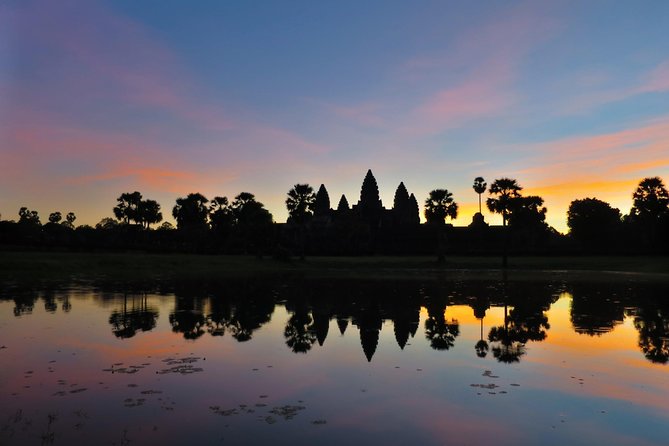
The largest religious monument ever constructed covers 162 hectares and represents the pinnacle of Khmer architecture, its five towers symbolizing Mount Meru—the home of the gods—while nearly 2,000 apsara dancers carved into the walls represent celestial beauty. The temple's orientation toward the west—unique among Angkorian temples—has spawned theories ranging from funerary function to solar symbolism while ensuring that sunrise illuminates the towers in the most photographed moment in Southeast Asian tourism. The bas-reliefs depicting the Churning of the Ocean of Milk, the Battle of Kurukshetra, and scenes from the Ramayana stretch for 800 meters and represent the world's longest continuous bas-relief.
0 Minute
2
Angkor Thom
The last great capital of the Khmer Empire stretches across 9 square kilometers within walls 8 meters high, entered through five monumental gates where 54 stone deities line causeways crossing the moat in scenes representing the Churning of the Ocean of Milk. The South Gate—the best preserved and most photographed—provides the dramatic entrance that prepares visitors for the wonders within. The city's scale, road network, and the multiple temples within its walls demonstrate the sophistication of Khmer urban planning at its height.
0 Minute
3
Bayon-Tempel
The state temple of Jayavarman VII creates one of the world's most mysterious and mesmerizing experiences through its 216 serene stone faces gazing from 54 towers in every direction—perhaps representing the king, the bodhisattva Avalokiteshvara, or the empire itself watching over its subjects. The temple's apparent chaos of towers and galleries resolves when understood as a symbolic Mount Meru, while the bas-reliefs on the outer galleries uniquely depict daily life—markets, battles, cock fights—rather than purely mythological scenes. The faces' enigmatic smiles, illuminated by morning or evening light filtering through the towers, create photography opportunities that reward multiple visits.
0 Minute
4
Ta Prohm
The jungle temple where massive silk-cotton and strangler fig trees have engulfed the ruins creates the most photogenic decay in the archaeological world, its galleries serving as the setting for Tomb Raider and countless Instagram posts since being left largely unrestored to show how all Angkor temples appeared when French explorers arrived. The temple's official name was Rajavihara—'royal monastery'—and served as a Buddhist monastery housing 12,000 people and receiving support from 600,000 civilians when the inscription was carved. Navigating the root-encased corridors and collapsed galleries requires patience during peak hours but rewards with discoveries around every corner.
0 Minute
5
Banteay Srei
The 'Citadel of Women' 25 kilometers northeast of Angkor preserves the most intricate and best-preserved carvings in Khmer art, its pink sandstone allowing detail impossible in the softer laterite and sandstone used at Angkor. The temple's small scale—the central towers are barely 10 meters high—belies its artistic importance, with carvings so fine they suggest wood or metal rather than stone. The journey through rural villages and the temple's relatively uncrowded atmosphere make the expedition worthwhile for those seeking depth beyond the essential Angkor temples.
1 Stunde
6
Terrasse der Elefanten
The 350-meter terrace served as the viewing platform for royal ceremonies, its carved elephants and garudas creating a dramatic backdrop for parades, military reviews, and the spectacles that demonstrated Khmer royal power. The life-sized elephant carvings at each end and the three-headed elephants—Airavata, Indra's mount—picking lotus flowers along the retaining walls demonstrate the Khmer mastery of monumental relief sculpture. The terrace's position facing the vast royal plaza provides context for understanding Angkor Thom's ceremonial function.
0 Minute
7
Für Rup
This 10th-century temple-mountain offers one of Angkor's finest sunset viewpoints, its steep pyramidal structure providing elevation above the jungle canopy for panoramic views as the sun descends behind the western temples. The temple's name—meaning 'turn the body'—suggests funerary function, possibly cremation rituals, while the architecture represents the development of the temple-mountain form between the earlier Bakong and later Angkor Wat. The atmospheric brick and laterite towers, carved
0 Minute
8
Tonle-Saft-Lack
Southeast Asia's largest freshwater lake expands from 2,500 square kilometers during dry season to over 16,000 during the monsoon, when the Mekong's floodwaters reverse the Tonlé Sap River's flow in one of the world's unique hydrological phenomena. The floating villages—where homes, schools, and even basketball courts float on the lake—provide glimpses of waterborne life that has sustained fishing communities for generations. The Kompong Khleang, Kompong Phluk, and Chong Kneas villages offer different experiences depending on season and tourism intensity.
0 Minute
9
Alter Markt
The riverside area near the Old Market preserves French colonial architecture—shophouses, villas, and the Grand Hotel d'Angkor—that dates from the early 20th century when French archaeologists began restoring Angkor and tourists required accommodation. The contemporary transformation has filled colonial buildings with boutiques, restaurants, and galleries while new development expands the tourist zone. The Siem Reap River's banks, the Angkor National Museum's modern interpretation of Khmer civilization, and the night market's energy create experiences complementing the ancient temples.
1 Stunde
10
Pub Street
Siem Reap's entertainment district packs bars, restaurants, and street vendors into a pedestrianized zone where backpacker beer promotions coexist with upscale cocktail lounges and the massage parlors that seem to outnumber restaurants. The adjacent night markets sell souvenirs, clothing, and handicrafts at negotiable prices while food stalls offer everything from fried tarantulas (tourist novelty) to excellent Khmer noodle soups (local staple). The area's intensity polarizes visitors, but its concentration of services makes it inevitable for evening meals and the social scene.
1 Stunde
11
Phalla Angkor Night Market Siem Reap
Cambodia's cuisine—nearly erased during the Khmer Rouge years when recipes died with their keepers—has been rediscovered and revitalized through the efforts of chefs, researchers, and the diaspora who returned with memories and family traditions. Fish amok—the curry steamed in banana leaves—represents the national dish while beef lok lak, nom banh chok rice noodles, and the ubiquitous prahok fermented fish paste define everyday eating. Cooking classes, restaurant scene ranging from street stalls to fine dining, and the markets where ingredients reveal themselves provide immersion into a cuisine distinct from neighboring Thai and Vietnamese traditions.